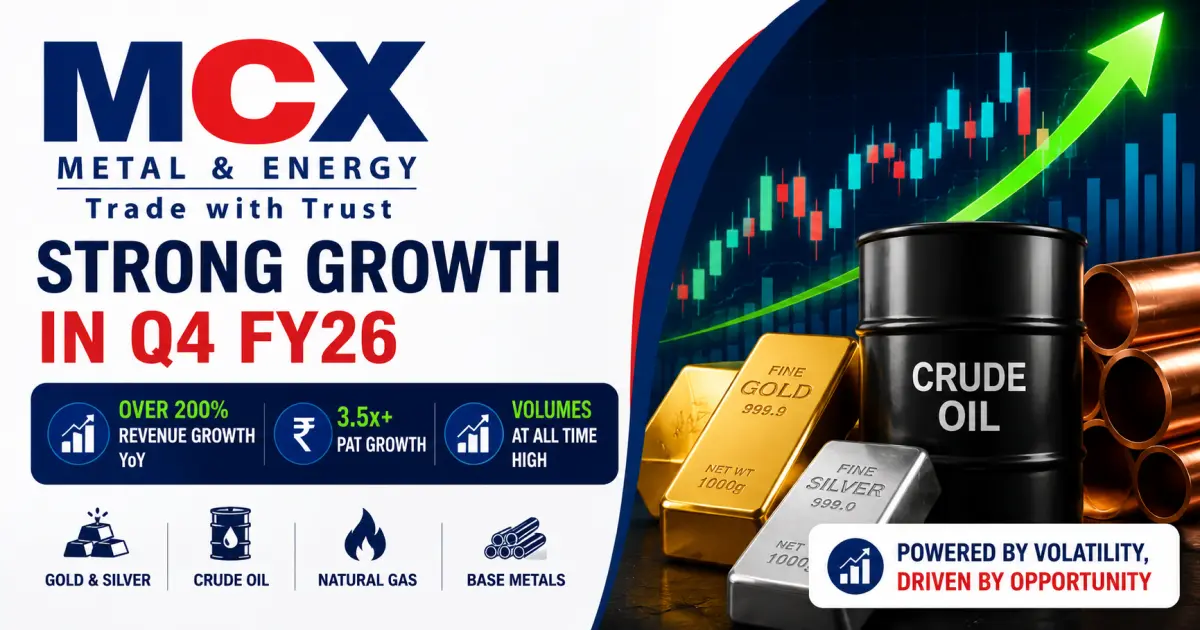
Multi Commodity Exchange of India (MCX) delivered a very strong performance in Q4 FY26, mainly supported by higher trading activity in bullion and energy commodities. Rising geopolitical tensions and uncertainty in global energy markets kept commodity prices highly volatile during the quarter, which significantly increased participation across futures and options trading.
The company reported over 200% YoY growth in operating revenue, highlighting the strong momentum in commodity derivatives activity. Total income increased 189% YoY to ₹925 crore, while EBITDA surged 271% YoY to ₹703 crore. Profit After Tax (PAT) also witnessed exceptional growth of 291% YoY to ₹530 crore, showing the strong operating leverage in the business model.
Trading volumes remained the biggest growth driver during the quarter. Futures Average Daily Turnover (ADT) rose 111% YoY to ₹90,199 crore, while Options ADT increased 112% YoY to ₹5,75,387 crore. The sharp rise in trading activity across bullion and energy contracts helped MCX report strong growth in both revenue and profitability.
The quarter clearly showed how elevated volatility in commodity markets continues to support MCX’s transaction-based business model, where higher participation from traders, investors, and hedgers directly contributes to stronger revenue growth and profitability.
Read more; BSE Business Analysis
MCX business model
MCX mainly operates as a commodity derivatives exchange platform where traders, investors, institutions, and businesses trade futures and options contracts linked to commodities such as gold, silver, crude oil, natural gas, and metals. The company earns revenue primarily through transaction fees charged on every trade executed on its platform.
This means MCX’s business is highly volume-driven. Whenever trading activity rises, the exchange benefits through higher transaction income. Commodity volatility plays a very important role in this business model because higher price fluctuations generally attract more traders, hedgers, and arbitrage participants into the market.
The recent energy crisis and geopolitical tensions significantly increased volatility in bullion and energy contracts. As prices moved sharply, traders became more active in futures and options trading. At the same time, industries that are directly affected by commodity prices, such as automobile companies, airlines, manufacturers, and industrial businesses, also increased their hedging activity to protect themselves from sudden price movements. This overall rise in participation supported strong volume growth for MCX.
Rising Participation Across Commodity Trading
MCX has also witnessed strong growth in client participation over the last few years. The number of traded clients in futures, options, and the overall F&O segment has increased consistently, showing broader adoption of commodity derivatives in India.
The F&O traded client base increased from 6.2 lakh in FY23 to 20.9 lakh in FY26, which reflects growing retail as well as institutional interest in commodity markets. This increase in participation is important because higher active users directly support long-term transaction growth for the exchange.
The company is also improving its distribution ecosystem by integrating brokers and allowing easier participation for clients. Banks-sponsored broking entities are now allowed to provide commodity derivative services, while professional clearing memberships are expanding as well. These initiatives help improve accessibility and increase market penetration.
New Products and Strategic Growth Initiatives
MCX is also focusing on expanding its product portfolio to increase engagement among traders and institutions. The company has introduced new products such as cardamom futures, nickel futures, monthly gold and silver options, and electricity derivatives.
These new contracts help diversify the exchange’s trading ecosystem and create additional opportunities for market participants. Electricity derivatives, in particular, could become an important segment over the long term as India’s energy markets continue evolving.
Apart from this, MCX is also working toward increasing commodity index options and strengthening domestic delivery infrastructure. These initiatives are aimed at improving liquidity, broadening participation, and making commodity trading more integrated with the financial ecosystem.
Another important positive factor for MCX is the gradual rise in institutional participation within commodity markets. Mutual funds can now participate in commodity derivatives through hybrid schemes and Gold & Silver ETFs. Portfolio managers and Foreign Portfolio Investors (FPIs) are also getting broader access to exchange-traded commodity products.
This is a significant structural development for the commodity ecosystem because many investors who traditionally participated only in equities are now slowly getting exposure to commodities through regulated investment products like ETFs. As awareness regarding gold, silver, and commodity-based investing increases, exchanges like MCX can benefit from rising institutional and retail participation over the long term.
Strong Financial Growth After FY23
The company’s financial trend clearly shows how commodity market volatility has supported its earnings growth. After FY23, MCX witnessed a sharp rise in revenue, operating profit, and margins. Sales increased from ₹514 crore in FY23 to ₹684 crore in FY24, then further jumped to ₹1,113 crore in FY25 and ₹2,302 crore in FY26.
Operating profit also surged significantly from ₹63 crore in FY24 to ₹665 crore in FY25 and further to ₹1,642 crore in FY26. Operating margins improved sharply as well, rising from 9% in FY24 to 71% in FY26.
This improvement largely came because of exceptionally strong commodity trading activity during the global energy and geopolitical crisis period.
Key Risk Factors for MCX
Although MCX is currently benefiting from elevated market volatility, this also creates an important risk factor for the business.
A major portion of the company’s recent growth has been supported by the Russia-Ukraine war and the ongoing Middle-East conflict. These events kept commodity prices highly unstable, which increased speculative trading, arbitrage opportunities, and hedging demand across bullion and energy contracts.
As long as global geopolitical tensions remain elevated, commodity markets are likely to stay active, which can continue supporting strong transaction volumes for MCX. If energy-related uncertainty increases further or conflicts widen globally, the exchange may continue witnessing healthy growth in trading activity and profitability.
However, if global conditions stabilize and major geopolitical conflicts move toward settlement, commodity price volatility may reduce significantly. In such a scenario, speculative participation in futures and options contracts could slow down. Hedging demand from industries may also decline if commodity prices become more stable.
At the same time, investor attention could gradually shift back toward equity markets if economic conditions improve globally. Lower commodity volatility generally reduces short-term trading opportunities, which may directly affect MCX’s transaction-based revenue model.
Therefore, while MCX is currently benefiting strongly from the global commodity cycle, future growth will largely depend on how geopolitical conditions and commodity market volatility evolve over the coming years.
Conclusion
MCX has delivered a very strong performance in Q3 FY26, supported by sharp growth in commodity trading activity, especially across bullion and energy derivatives. Rising participation from retail traders, institutions, hedgers, and arbitrage participants helped the company report strong revenue growth, margin expansion, and profitability improvement.
The company is also strengthening its long-term growth ecosystem through broader institutional participation, ETF-linked commodity investing, new derivative products, and improved market accessibility.
However, a large part of the current momentum is still closely tied to global geopolitical uncertainty and energy market volatility. If these conditions remain elevated, MCX may continue witnessing healthy transaction growth. But if global commodity markets stabilize and volatility declines, growth rates and profitability may gradually normalize from current high levels.
What is MCX’s Business Model?
Multi Commodity Exchange of India earns money mainly through transaction fees from commodity trading in futures and options contracts like gold, silver, crude oil, and natural gas. Higher trading volumes directly increase the company’s revenue and profitability.
What is the Future Growth Potential of MCX?
MCX’s future growth can come from:
- Rising retail and institutional participation
- Growth in Gold & Silver ETFs
- New contracts like electricity derivatives
- Higher hedging demand from industries
- Expansion of India’s commodity market
Will MCX Continue Growing Like This?
MCX’s recent strong growth is mainly supported by high commodity volatility due to the Russia-Ukraine war and Middle-East tensions.
- If geopolitical tensions continue, trading volumes may remain strong.
- If global conditions stabilize, commodity volatility and trading activity may reduce, which can slow MCX’s growth and profitability.
So, long-term growth potential remains positive, but current exceptional growth may normalize if commodity markets become stable again.