As the Indian economy is growing, retail participation in the market is increasing significantly in the digital economy, and the share of this segment in the economy is also rising. Due to this, various corporates and investors are emerging along with the growing economy. There are many factors affecting this growth, and one of the key beneficiaries is the BSE, India’s oldest exchange, which is delivering skyrocketing financial performance in this rising economy.
The company’s revenue has increased significantly, even though the market has not made a new high in the past 1.5 years. The company’s revenue increased by nearly 104% in FY25 compared to FY24
How does BSE make money
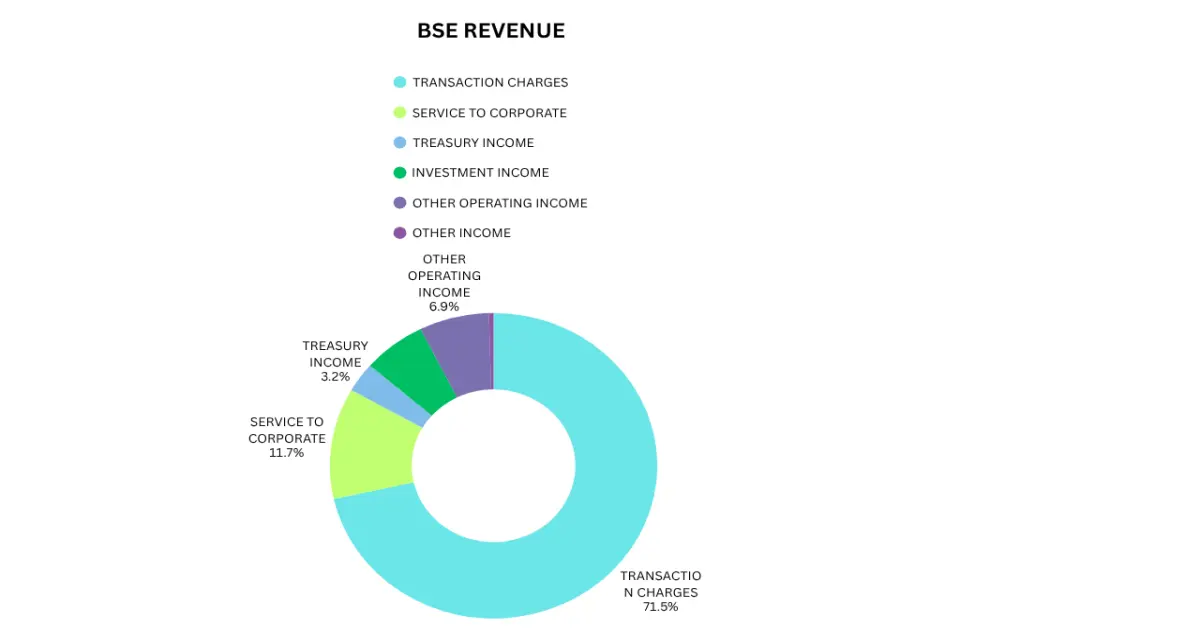
The company operates through several different segments to generate revenue. Some of the major sources of revenue include transaction charges, services provided to corporates, treasury income, other operating income, and investment income.
One of the company’s biggest revenue contributors is transaction charges, which remain the core driver of the overall business.
Transaction charges
As per Q3 FY26, the recent quarter results explained that the majority of the company’s revenue comes from transaction charges, which are the key pillar of BSE’s business. More than 70% of the company’s business revenue is generated from this segment.
This business is directly linked to market activity. For example, BSE earns money based on how actively the listed equities and shares on the exchange are traded. Higher trading activity leads to higher transaction charge income for the company.
It has also been observed that when the market becomes volatile, trading activity increases significantly compared to periods when the market remains sideways. This is why transaction charge revenue tends to rise sharply during strong market rallies or highly active market phases.
So, it is directly connected that if the market and the Sensex continue to make higher highs, there will be more fluctuation and trading activity in equities. As a result, higher trading volumes ultimately generate more transaction charge income for BSE.
Services to corporates
The second major source of revenue for the company is services provided to corporates, which is also a significant segment, as nearly 11% of the company’s revenue comes from it.
In this segment, the company earns money through corporate actions, listing fees, and various corporate filings. Whenever a company undertakes corporate activities or files documents related to compliance and listing requirements, BSE earns service revenue from those corporates.
This segment is strategically very important because, as startups grow and more companies get listed on BSE, it positively impacts the company’s business. This is considered a relatively stable and recurring source of revenue because once a company is listed on the BSE exchange, it has to pay annual listing-related fees and other service charges.
Therefore, this segment plays a key role in providing stable and long-term revenue generation for BSE.
To understand the stability of BSE’s business, the services provided to corporates segment is very important. The company’s annual listing fee revenue has been growing strongly because, regardless of market conditions, listed companies must continue to avail these services and pay annual listing fees to remain listed on the BSE.
The company’s revenue from annual listing fees increased from ₹192 crore in FY24 to ₹224 crore, which is a very important sign of stable growth. Additionally, revenue from listing processes and other related fees increased significantly from ₹79 crore in FY24 to ₹352 crore.
As more companies continue to get listed on the BSE, this revenue segment is expected to grow even further. This also provides greater stability to BSE’s overall revenue business.
The company also has other sources of revenue, such as treasury income, data dissemination fees, licensing fees, and other operating income. Additionally, the company earns income from investments and deposits, through which it generates returns in the form of yields and interest income.
Key Sustainability, High Valuation, and Future of the Business
One of the key things observed is that since the company launched its equity derivatives, F&O, and several other segments, BSE has been delivering very strong business growth. If we look at the company’s growth over the last few years, especially the three-year growth rate, the company has delivered growth of more than 50%, which is considered an excellent growth rate.
What makes this more important is that this growth has come even when the equity markets, including the Nifty and Sensex, have not made significant new highs over the past year. This highlights the sustainability and strength of the company’s business model.
This is also one of the key reasons why the company is trading at a higher valuation. Currently, the company’s PE ratio is around 74, and it is trading at nearly 30.5 times its book value. The market is giving this premium valuation because the company’s future business outlook remains very strong.
More and more companies, especially SMEs and IPOs, are getting listed on the exchange. Additionally, BSE continues to generate recurring revenue through corporate actions, annual listing fees, and other corporate services. These segments are becoming very important for generating stable and consistent revenue for the company, which strengthens the sustainability of the overall business.
Another major advantage is the high entry barrier in the exchange business. Opening and operating a stock exchange is not easy, which gives BSE a strong competitive advantage. Along with this, the Indian capital market itself is growing rapidly, while exchanges like NSE continue to focus heavily on the F&O segment, which further increases the future growth potential of the overall exchange industry.
All these factors together improve the future probability, sustainability, and long-term growth prospects of BSE’s business. That is why the market is assigning a higher valuation to the company.
The company also has several subsidiaries that contribute significantly to its overall business growth. A notable portion of the services-to-corporates business is connected to subsidiaries such as CDSL and other related businesses.
These subsidiaries strengthen the company’s overall business ecosystem and provide additional sources of stable and sustainable revenue. As a result, the subsidiary businesses also play an important role in improving the long-term sustainability and growth potential of the company.
The company has strong future potential in the coming years because the growing economy has a direct positive impact on its business. One of the biggest advantages is the services-to-corporates segment, where the company earns revenue through annual maintenance fees, listing fees, and various corporate service charges. As the number of listed companies increases, the company will continue to generate higher service-related revenue and earnings.
The second major growth driver is increasing retail participation in the market. If more retail investors participate in the stock market and trading activity on the exchange rises, the company will generate higher revenue from transaction charges. Therefore, both major business segments provide strong long-term growth opportunities for the company.
However, one concern is the company’s high PE ratio, which could result in comparatively lower future returns from the stock price perspective. While the company may continue to deliver sustainable business growth, its already high valuation could limit the scope for extremely high returns in the future.
How does BSE generate most of its revenue?
BSE mainly generates revenue through transaction charges, corporate services, annual listing fees, treasury income, data dissemination fees, and investment income. Transaction charges remain the company’s largest revenue contributor.
Why are transaction charges important for BSE?
Transaction charges are directly linked to market activity and trading volumes. When retail participation and market volatility increase, trading activity rises, which helps BSE earn higher transaction fee income.
Why is the services-to-corporates segment considered stable?
This segment provides recurring revenue because listed companies must continue paying annual listing fees, compliance fees, and other service charges regardless of market conditions.
What are the key future growth drivers for BSE?
The major growth drivers include rising retail participation in the Indian stock market, increasing SME and IPO listings, growth in the F&O segment, and expansion of corporate services and subsidiary businesses.
What is the major concern regarding BSE’s valuation?
One of the biggest concerns is the company’s high PE ratio. Although the business fundamentals and growth prospects remain strong, the already high valuation could lead to comparatively lower future stock returns.
1 Comment