Ather Energy has been making headlines after the stock reached a new all-time high following the announcement of its Q1 FY27 results. The company has delivered a much stronger performance than many expected, with its current business showing strong momentum and, more importantly, EBITDA turning positive for the first time.
This is an important development because Ather Energy had been giving strong expectations regarding its upcoming business performance. However, there were also several concerns around commodity prices, the West Asia crisis, cash flow and the pace at which the company could expand its business.
The latest results have now provided some confidence that the company’s projections are actually moving in the right direction.
The bigger question now is whether Ather Energy can maintain this momentum and convert the strong demand it is currently seeing into sustainable growth.
EBITDA Turns Positive Despite Multiple Challenges
One of the biggest developments in the latest quarter was Ather Energy reporting positive EBITDA.
Over the past couple of quarters, the company had highlighted concerns related to the West Asia crisis and rising commodity prices. These factors could have put pressure on margins and potentially made the company’s earlier EBITDA expectations difficult to achieve.
However, despite these challenges, Ather Energy has managed to turn EBITDA positive — and the trend line shows just how sharp the turnaround has been:
| Quarter | EBITDA Margin | EBITDA (₹ crore) | QoQ Change | Commentary |
| Q3 FY’26 (Oct–Dec 2025) | -3% (just under) | ~-₹29 crore | +700 bps QoQ, +1,600 bps YoY | Improving steadily on operating leverage from Rizta demand |
| Q4 FY’26 (Jan–Mar 2026) | -2% | Not explicitly stated in ₹ crore | +2,000 bps QoQ (from -23% to -2%)* | Sharpest improvement of the year; strong cost discipline + AGM gains |
| Q1 FY’27 (Apr–Jun 2026) | +0.8% | +₹9 crore | +~280 bps QoQ | First-ever positive EBITDA quarter — despite a 5.6% commodity-cost hit to margins |
This is important because it gives more confidence in the company’s business projections. The company is no longer only talking about future profitability; it has now started showing improvement in its actual financial performance.
The positive EBITDA also supports the company’s cash flow position and makes its future guidance look more sustainable.
This has been one of the major factors behind the recent improvement in investor confidence and the sharp movement in the stock price.
Strong Demand Is Creating a New Problem for Ather
The interesting part of Ather Energy’s current situation is that the company is facing a problem that is actually coming from strong demand.
The company has seen robust deliveries and strong business momentum, which has encouraged it to increase its capital expenditure.
At the same time, the company’s stores are currently able to fulfil only around 50–60% of the underlying demand because of supply constraints.
This means that the company is not necessarily facing a lack of demand. Instead, the challenge is increasing production capacity quickly enough to fulfil the demand that is already available.
This is a negative factor in the short term because some potential sales could be delayed. But at the same time, it is also a positive problem because the company is increasing its capacity in response to strong demand.
In other words, the company needs more capacity because the existing business is growing faster than expected.
Dealer Inventory Falls From 14 Days to Around 3 Days
Another important improvement can be seen in dealer inventory.
Earlier, dealer inventory was around 14 days. It has now come down to approximately three days.
This is a significant change because lower dealer inventory generally indicates that products are moving faster through the distribution network.
For Ather Energy, this is particularly important because the company is currently seeing strong demand.
The reduction in inventory suggests that the company is not simply pushing large quantities of vehicles into its dealer network. Instead, the underlying demand appears to be absorbing the available supply much faster.
This provides another positive indication regarding the company’s business momentum.
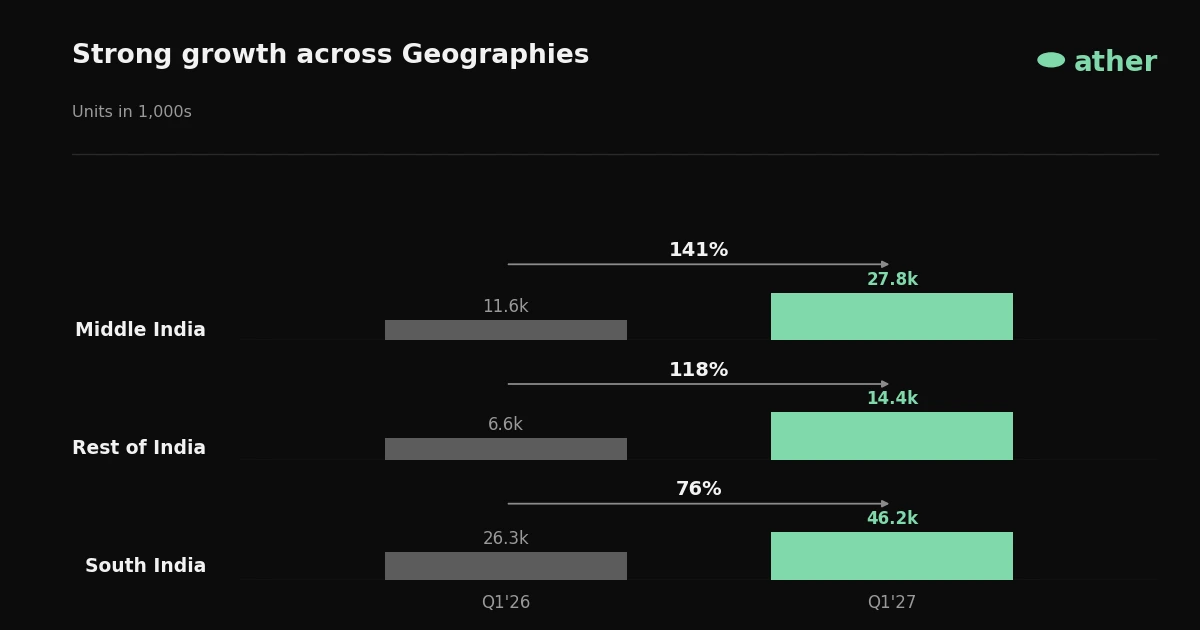
Ather Energy has also been seeing improvement in its market share across different parts of India.
North India has become an important growth area for the company, with Rajasthan and Punjab emerging as major contributors. The company has reached market share in the mid-teens in both states.
This is important because North India has significant potential for electric two-wheelers, and improving market share in these markets could provide another growth opportunity for Ather.
The company is also performing strongly in South India, where it has a significant market share of nearly 25%.
Therefore, the company is not dependent on only one geographical market.
Its improving presence across both North and South India gives it a wider base from which it can expand its overall two-wheeler EV business.
Capacity Expansion Could Become the Next Major Growth Driver
With demand increasing rapidly, Ather Energy has already started working on significant capacity expansion.
The company has announced that its new factory in Aurangabad is expected to reach a production capacity of around 42,000 units per month by the end of FY27.
But this is not the only capacity expansion opportunity available to the company.
Ather has also acquired additional land, which could allow it to expand its production capacity further to more than 1 lakh units per month.
This could become a major factor for the company’s future growth.
The reason is simple: Ather is already seeing strong bookings and demand, but its ability to fulfil that demand is currently limited by production capacity.
Once the additional capacity becomes operational, the company could potentially convert a much larger portion of its existing demand into actual deliveries.
However, there will naturally be a time gap between announcing the expansion, installing the required infrastructure, starting production and eventually delivering vehicles to customers.
Therefore, capacity expansion is both a positive and a negative factor.
It is a negative in the short term because the company cannot immediately fulfil all the demand it is seeing.
But it is a positive sign for the longer term because the reason behind the expansion is strong demand rather than weak utilisation.
Read more: ola business model
EL Platform Could Open a New Mass-Market Segment
Another major development for Ather Energy is the upcoming EL platform.
The company has already started production of the platform at its Hosur facility, and it is scheduled to be officially unveiled at Community Day on 29 August.
The launch of this platform could become an important development because Ather has indicated that it could help the company enter a new mass-market segment.
The expected price range is around ₹1 lakh to ₹1.25 lakh.
This would allow Ather to target a much broader customer base compared with its existing positioning.
The company is also focusing on developing a lower-cost architecture for the platform.
For example, the EL platform is expected to use steel frames instead of aluminium frames, while also using simpler transmissions.
These changes could help the company control production costs and make its products more accessible to a larger part of the Indian two-wheeler market.
The company is not only focusing on reducing costs.
Ather is also introducing new technology with the platform, including an advanced electronic braking system (AEBS) and new charging technology.
This is important because the mass-market segment is highly competitive.
Ather needs to balance three things at the same time: price, technology and profitability.
If the company can introduce a product in the ₹1 lakh–₹1.25 lakh range while maintaining its technology and brand positioning, the EL platform could become an important contributor to future volumes.
The success of this platform will therefore be something investors will closely watch after its official launch.
Strong Demand Is Coming Earlier Than Expected
The most interesting part of the current Ather Energy story is that the company’s growth appears to be coming faster than management had expected.
The company has already been planning capacity expansion, but the speed at which demand has increased has created a situation where capacity is now becoming a bottleneck.
Its facilities are operating at nearly full capacity, and the next phase of growth may depend not only on demand but also on how quickly Ather can execute its capacity expansion.
Why the Stock Has Seen Such a Strong Move
The recent rise in Ather Energy’s stock price can be linked to several developments coming together at the same time: positive EBITDA for the first time, sharply lower dealer inventory, improving market share across Rajasthan, Punjab and South India, and a clear capacity-expansion roadmap — including the Aurangabad facility and additional land that could eventually support production of more than 1 lakh units per month.
The upcoming EL platform provides another potential growth driver by allowing Ather to enter a larger mass-market segment.
Together, these factors have changed the way investors are looking at the company.
Earlier, the focus was largely on whether Ather could achieve the growth and profitability targets it had been talking about.
Now, the discussion is increasingly shifting toward how quickly the company can expand capacity and fulfil the demand that is already coming through.
The Key Risk: Can Capacity Keep Up With Demand?
Despite the strong developments, there is still an important risk that investors need to watch.
Demand can increase quickly, but building production capacity takes time.
Ather Energy has already announced its expansion plans, but the benefits from these investments will only be visible once the new facilities and production lines become operational.
If demand continues to grow faster than capacity, the company could lose some potential sales because of supply constraints.
At the same time, if the company expands capacity too aggressively and demand eventually slows, it could face the opposite problem of lower utilisation and higher fixed costs.
Therefore, the execution of the capacity expansion will be extremel