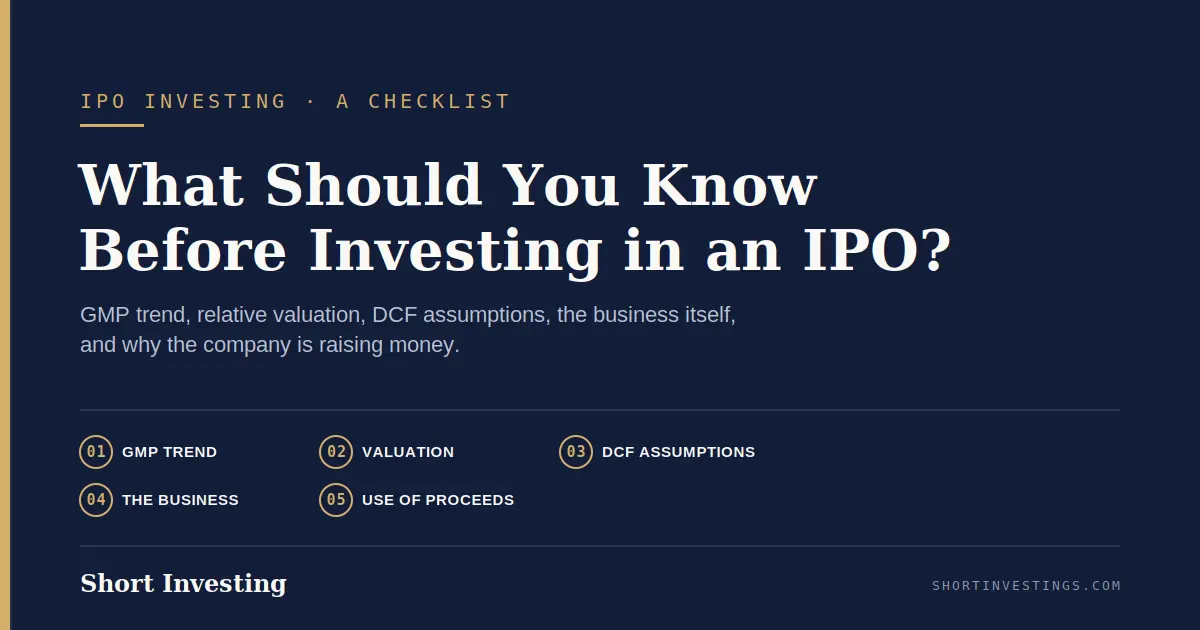
There are various ways to invest in the market — mutual funds, direct stock investments, ETFs, sectoral funds. So why does an IPO stand out from all these options? What makes it attractive, and what should you actually know before you apply for one?
Why an IPO Feels Different From Other Investments
When you invest in a mutual fund, you’re usually playing a long game — an SIP or a lump sum aimed at wealth creation over years. You don’t go in expecting a 10-12% return in a month or two.
Direct stock investing and ETFs can move faster — a stock can run 15%, 30%, even 40% in a few months. But finding that stock consistently is hard, and while your money is in it, you’re carrying market risk the entire time you’re holding it.
This is the core problem with most ways of investing in the market: it’s difficult to generate a high return in a short window without tying up your capital, and your risk, for months.
An IPO changes that equation. The application window is only a few days. If you get an allotment and the stock lists well, you could see a meaningful return almost immediately. If you don’t get an allotment, your money is released back to you. Either way, your capital isn’t locked up for long — which is a very different risk profile from holding a stock for months hoping it moves.
That said, listing gains are never guaranteed. A stock can list at a premium, at the issue price, or below it, depending on demand, valuation, market conditions, and sentiment on listing day.
Retail minimum investment is also fairly accessible — usually around ₹15,000 for a mainboard IPO, though SME IPOs typically require closer to ₹1 lakh or more.
So an IPO gives you another way to participate in the market, and potentially another dimension to how you diversify. But before you apply, there are a few things worth understanding properly.
Read more: How to Analyze an IPO: Fundamental, Technical, Risk and Valuation Analysis
1. Understand the Grey Market Premium — and Its Trend
The Grey Market Premium (GMP) is the price at which IPO shares trade unofficially, before listing, in an over-the-counter market. Most people stop at “what’s the GMP today” — but that’s only half the picture.
What matters just as much is whether the GMP is rising, falling, or holding steady. A GMP of ₹300 sounds attractive on its own. But if it was ₹500 a week ago and has been sliding since, that trend is telling you something the current number alone won’t. GMP is an unofficial, sentiment-driven indicator — not a guaranteed forecast of where the stock will list — so read it as a signal to watch over time, not a number to react to on a single day.
2. Understand the Valuation — Relative to Peers
A good company doesn’t automatically mean a good IPO. If the business is priced expensively relative to its listed peers, there may be limited room left for the stock to move after listing.
Look at valuation ratios like P/E (Price-to-Earnings) and P/B (Price-to-Book). If a company is coming in at a P/E of 50 while comparable peers trade at 25-30, ask why. It might be justified — stronger growth, better margins, a real competitive edge. Or it might just be an expensive IPO riding good sentiment. The question isn’t just “what’s the valuation,” it’s “does the business actually justify that premium.”
3. Understand How the DCF Valuation Was Built
Alongside relative valuation, look at the Discounted Cash Flow (DCF) approach, which tries to estimate a company’s intrinsic value from its expected future cash flows.
The number itself matters less than the assumptions behind it — revenue growth, EBITDA margins, operating cash flow, capex, free cash flow, working capital needs, WACC, terminal growth rate. Small shifts in any of these can swing the final valuation significantly. Don’t take a DCF number at face value just because someone quotes it — understand how it was arrived at.
Also read: IPO Explained: Valuation, GMP Formula & Key Benefits
4. Understand the Business Itself
Strip away the GMP and the valuation debate for a moment, and ask the basic questions: What does this company actually do, and how does it make money? Is revenue growing? Are margins improving? Is it profitable? What does the debt and cash flow position look like? What’s the real growth potential from here?
You’re not investing in an IPO — you’re investing in a business and its future performance. The IPO is just the entry point.
5. Understand Why the Company Is Raising Money
Check whether the IPO is a fresh issue, an Offer for Sale (OFS), or a mix of both. In a fresh issue, the money raised goes to the company — for expansion, debt repayment, working capital, or similar needs. In an OFS, existing shareholders are simply selling their stake, and the company itself doesn’t receive the proceeds.
Knowing which one you’re looking at tells you a lot about the intent behind the listing.
Paytm: Why Valuation Matters More Than Growth Alone
Paytm’s IPO is a useful lesson here. There was strong growth excitement around the company at the time, and its valuation was a big part of the debate. After listing, the stock fell sharply from its issue price. Even later, when the company’s revenue grew significantly, the stock didn’t simply climb back to its IPO price on the back of that growth alone.
Read more : paytm business model
The lesson: growth doesn’t automatically translate into stock returns. The price you pay for that growth matters just as much. If a stock is already priced for years of future growth, even genuinely strong execution may not be enough to generate good returns from that entry point.
GMP Alone Isn’t Analysis
The biggest mistake retail investors make with IPOs is looking only at the GMP. A high GMP makes a listing look exciting, but it tells you nothing about whether the company is actually undervalued or overvalued.
A fuller picture comes from putting several things together: GMP and its trend, business fundamentals, relative valuation, DCF valuation, sector outlook, and overall market conditions. No single number does the job on its own.
Final Thoughts
Mutual funds, ETFs, direct investments, sectoral funds, and IPOs each come with their own trade-offs. What makes an IPO attractive is the short application-to-listing window — apply, wait a few days, and if you get an allotment and the stock lists well, you could see a return quickly.
But that opportunity comes with real risk. Don’t apply just because the GMP looks high. Check whether it’s rising or falling, how the company is valued against its peers, what the P/E and P/B ratios say, how the DCF number was built, why the company is raising money, and whether the fundamentals actually support the price you’re paying.
Put those pieces together, and you’re no longer betting on an IPO — you’re making an informed decision about one.
3 Comments