Rentomojo Limited is seen to have a very unique kind of business model, and it is considered to be an asset-light business. The company represents a new era of technology-driven businesses and operates as a fully tech-enabled rental and subscription platform. Primarily, the company focuses on furniture and appliances.
The company simply purchases furniture and appliances and rents them to customers, through which it continuously generates revenue. The company has nearly 253,825 live subscriptions across 29 cities and 82 experience stores. One of the key strengths of the business is that the company has an occupancy rate of more than 80%, which strengthens the business across both segments.
| Enterprise Value | 5,220 |
| Less: Net Debt | 234 |
| Add: Cash & Investments | 32 |
| Equity Value | 5,019 |
| Shares Outstanding | 10.41 |
| Fair Value per Share | ₹ 482 |
| Current Market Price | ₹ 404 |
| Upside/Downside | 19.3% |
Nearly more than 90% of the company’s business comes from furniture rental and appliance rental. This has also enabled the company to achieve a growth rate of nearly 40% CAGR over the last three years. This makes the overall analysis and perspective stronger and provides a reason for considering a 40% growth rate as one of the key assumptions.
Rentomojo IPO Grey Market Price
Rentomojo Limited IPO is seen to have a very good and strong grey market price, nearly more than 35% on a constant basis. As the IPO is going to be listed on 17th September, the company’s IPO is showing strength in the grey market price.
However, it is important to understand why the grey market price is trading at a higher level and whether this premium can continue or not. A strong grey market premium does not necessarily mean that the stock will continue to trade at the same premium after listing. Therefore, it becomes important to understand the company’s fundamentals and valuation rather than looking only at the grey market price.
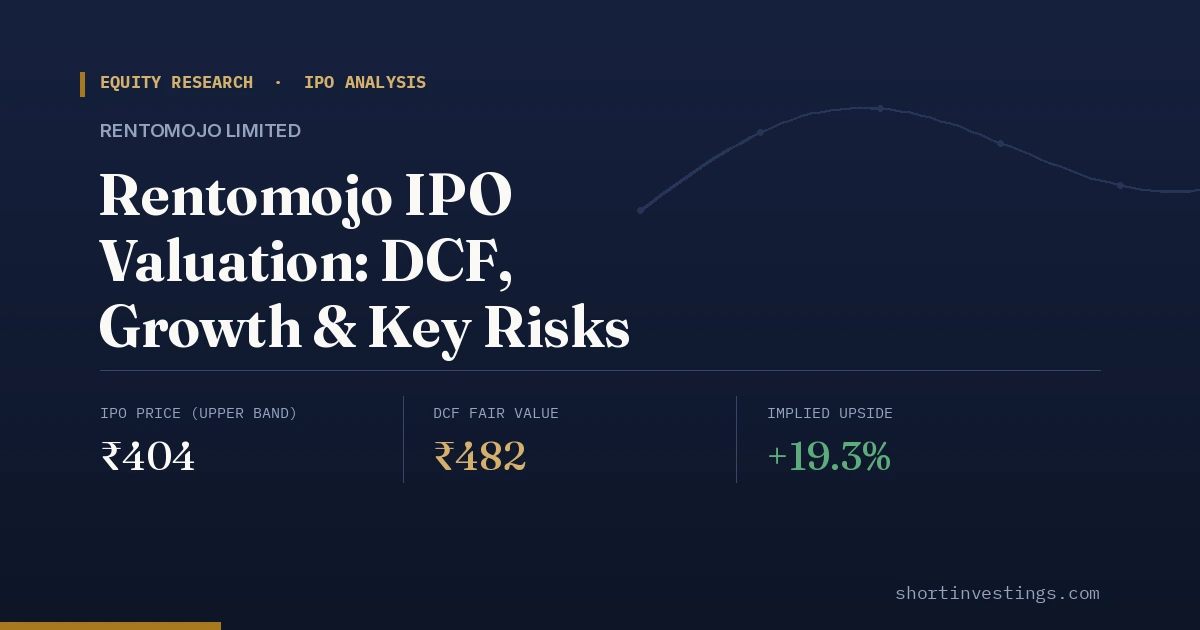
As per the discounted cash flow analysis, the price is already justified. Based on the growth rate and key assumptions, the stock is considered to have nearly 20% upside from the current value, which is currently around the ₹404 upper-band price.
So, it seems to be nearly 20% higher from that level, and that could be one of the reasons why the grey market price is trading at such a high premium.
Growth Rate and DCF Assumptions
| Revenue Projections & Growth Assumptions | |||||
| Year | FY27E | FY28E | FY29E | FY30E | FY31E |
| Revenue Growth % | 40% | 38% | 36% | 34% | 32% |
| Revenue (in Crs.) | 542 | 748 | 1,017 | 1,363 | 1,799 |
| Particulars | 2022A | 2023A | 2024A | 2025A | 2026A |
| Sales | 98.6 | 121.0 | 193.1 | 266.0 | 387.0 |
| % growth | 23% | 60% | 38% | 46% | |
| Cost of Goods Sold | 11.4 | 5.7 | 3.7 | 65.5 | 94.7 |
| % of revenue | 12% | 5% | 2% | 25% | 24% |
| Gross Profit | 87.2 | 115.4 | 189.4 | 200.5 | 292.3 |
| % margin | 88.4% | 95.3% | 98.1% | 75.4% | 75.5% |
| Operating Expenses | 88.5 | 90.3 | 125.4 | 86.0 | 129.6 |
| % of revenue | 90% | 75% | 65% | 32% | 33% |
| EBITDA | -1.4 | 25.1 | 64.0 | 114.5 | 162.7 |
| % margin | -1.4% | 20.8% | 33.1% | 43.0% | 42.0% |
| Net profit | -13.6 | 6.2 | 22.1 | 43.1 | 104.3 |
| Free Cash Flow Projections (₹ Crores) | |||||
| Particulars | FY27E | FY28E | FY29E | FY30E | FY31E |
| Revenue | 542 | 748 | 1,017 | 1,363 | 1,799 |
| EBITDA Margin % | 42% | 42% | 42% | 42% | 42% |
| EBITDA | 228 | 314 | 428 | 573 | 756 |
| Less: Depreciation | 64.61 | 89.16 | 121.25 | 162.48 | 214.47 |
| EBIT | 163 | 225 | 306 | 410 | 542 |
| Less: Tax | 40.80 | 56.30 | 76.57 | 102.60 | 135.43 |
| NOPAT | 122 | 169 | 230 | 308 | 406 |
| Add: Depreciation | 65 | 89 | 121 | 162 | 214 |
| Less: Reinvestment | (61) | (84) | (115) | (154) | (203) |
| Free Cash Flow to Firm | 126 | 174 | 236 | 316 | 418 |
If we take the base growth from the past years and also assume a 2% tapering rate, we are assuming that the company’s growth rate will be lower by 2% each year. As explained, we are starting with a 40% growth rate and then moving towards 38%, and accordingly, we create the free cash flow projections.
The purpose of using the tapering rate is to make the growth assumption more realistic. A company may achieve a very high growth rate during its initial high-growth period, but it may become increasingly difficult to maintain the same rate as the business becomes larger.
Here, we also assume a terminal growth rate of 5% for the company. This means that after a certain period of time, the company is expected to grow at nearly 5% annually.
These assumptions make the overall calculation more realistic. Based on the DCF valuation, we are seeing nearly a 20% upside, which represents a premium of approximately ₹78 per share.
This is why the company is getting a higher valuation, and it is also supporting the possibility of a strong listing.
Where Our Analysis Could Fail
We also have to understand where our analysis could fail or where our assumptions could be misjudged. In any DCF valuation, the final valuation depends heavily on the assumptions used for growth, WACC and terminal growth.
Here, we have taken a WACC rate of nearly 11%, which is one of the key assumptions, especially for a high-growth company.
The second important assumption is the revenue growth rate. We have taken the average growth rate based on the company’s growth over the last three years and used it as our expected growth rate. We have also taken a terminal rate of 5%. At the same time, the sector is also considered to be growing at nearly 11%, which is why we have reached this conclusion based on our key assumptions.
However, we have to understand that if anything changes—for example, if a new competitor enters the market and establishes a strong business—it could become challenging for the company to maintain a 40% growth rate.
If the company is unable to maintain the expected growth rate, the free cash flow projections could be lower than our current estimates. This could ultimately have an impact on the DCF valuation and reduce the potential upside.
At the same time, valuation is always based on the current set of assumptions and available information. If a new competitor enters the market or there is any significant change in the business environment, we would have to create different scenarios and analyse the valuation again.
Therefore, the current valuation should not be considered a permanent or fixed valuation. It is based on the assumptions we are using today. Any major change in revenue growth, margins, competition, WACC or terminal growth could change the valuation.