Every company’s growth rests on two pillars: the strength of its core idea and the growth happening in its sector. But to actually run and expand a business, you always need capital.
There are several ways to raise that capital, and each comes with its own cost. Take a loan, and you carry interest, which pushes up your overall cost. Wait instead for profits to fund growth, and you lose speed — you can’t move as fast as the industry or your own ambitions demand.
So companies look for a way to raise money quickly, keep costs low, and protect their financial health. That’s exactly the gap an IPO fills.
How Does an IPO Help a Company Raise Capital?
An IPO isn’t just a fundraising event — it serves several purposes at once.
When a company raises capital by issuing new shares, it dilutes its equity: new shares go to investors willing to buy in, and the company receives the capital without taking on the interest cost of a loan.
An IPO can also include an Offer for Sale, where existing shareholders sell their shares. Here, the money goes to those selling shareholders, not to the company itself. So it’s worth checking whether a given IPO is raising fresh capital for the company or simply giving existing shareholders an exit.
An IPO also brings in different kinds of participants — retail investors on one side, strategic investors on the other — each playing a distinct role.
Beyond capital, an IPO builds the brand. When people invest in a company and start tracking its decisions, that visibility compounds. Once listed, the stock becomes a talking point precisely because so many participants are now watching it — its financials, its profitability, everything.
Listing also gives investors a clearer window into the company: how it runs, how customers experience its products, and how transparently it operates. Taken together, these are genuine upsides for any company that chooses to go public.
Also read: What Should You Know Before Investing in an IPO?
Why Does the Government Encourage IPOs?
Regulators also have a stake in developing a healthy public capital market and the framework that lets companies access it.
Once listed, a company must publish annual reports, quarterly results, and a range of other disclosures. These requirements build transparency and give investors a much clearer read on the company’s financial performance. So an IPO does more than raise capital — it pulls the company into a more transparent, publicly accountable environment.
How Is an IPO Valued?
Because an IPO marks a company’s first appearance in the public market, pinning down the right price and valuation matters enormously — to the company, the bankers, and every investor evaluating it.
This is typically worked out through internal financial analysis using a mix of valuation methods: asset-based valuation, cash-flow-based approaches like DCF, and peer comparisons or relative valuation. Together, these methods test whether the IPO price is reasonable given the company’s financials, assets, future cash flows, and how its peers are valued.
Alongside this, investors pay close attention to the grey market price (GMP) — one of the clearest early signals of how the market is reading an IPO before it officially lists.
That said, the GMP is not a promise of returns if you get an allotment. It’s simply an indication of the premium at which the IPO might list. Investors track it and watch how it shifts between the IPO announcement and the actual listing.
Once the stock lists, supply and demand take over, along with the usual market forces. But before that moment, the GMP is one of the few signals investors have to go on.
How to Track the Grey Market Price?
Tracking the GMP comes down to two things: watching how comparable companies in the same sector are valued, and watching how the IPO is actually trading in the OTC (over-the-counter) market.
The OTC market isn’t regulated by Indian stock exchanges or any official body — it’s an informal space where prices get quoted person-to-person. Certain brokers and market participants share what the IPO is trading at in this grey market, and historically, certain locations in India — including Bombay and smaller hubs like Phalodi in Rajasthan — have been associated with this kind of informal trading activity. Because there’s no official regulation behind it, the GMP is inherently less reliable than an exchange-quoted price — but it still offers a useful read on sentiment.
Since there’s no official exchange data for the GMP, investors typically rely on informal market participants and the handful of Indian websites that track and publish these numbers.
How Does the Grey Market Price Change?
For a listed stock, price discovery is straightforward — you watch supply, demand, and sentiment play out on the exchange. But how does an unlisted stock’s grey market price get set?
Largely by the same forces that move listed companies. Peer valuations and how comparable companies are moving matter. Sector-specific policy or data releases matter. Broader geopolitical developments matter too, since they shape overall market sentiment.
When markets fall, IPOs tend to struggle to make a strong debut — the weak sentiment discourages the enthusiasm you’d otherwise see in a bull run, and retail or QIB (Qualified Institutional Buyer) demand can fall short of what the issue needs, dragging down subscription levels.
In a bullish market, the opposite tends to hold — IPOs draw stronger demand, and heavy subscription can signal a positive listing. But even then, it’s not a guarantee: conditions and investor expectations can shift right up to the listing date.
What Actually Influences the GMP?
Put simply, the GMP is never driven by one factor alone. It responds to peer company performance, relative valuations, government policy, sector data, geopolitical events, overall market sentiment, and how heavily the issue gets subscribed.
Company fundamentals and valuation matter, but so does the market environment around the listing. An IPO priced reasonably in a strong sector will usually carry positive sentiment; one that looks expensive, or lands during a falling market, will often see its GMP come under pressure.
That’s why the GMP number alone isn’t enough. It’s worth reading alongside the company’s valuation, its sector, its peers, prevailing market conditions, subscription levels, and overall sentiment.
IPO Price, GMP and Listing Price
The IPO issue price, the grey market price, and the actual listing price are three distinct numbers.
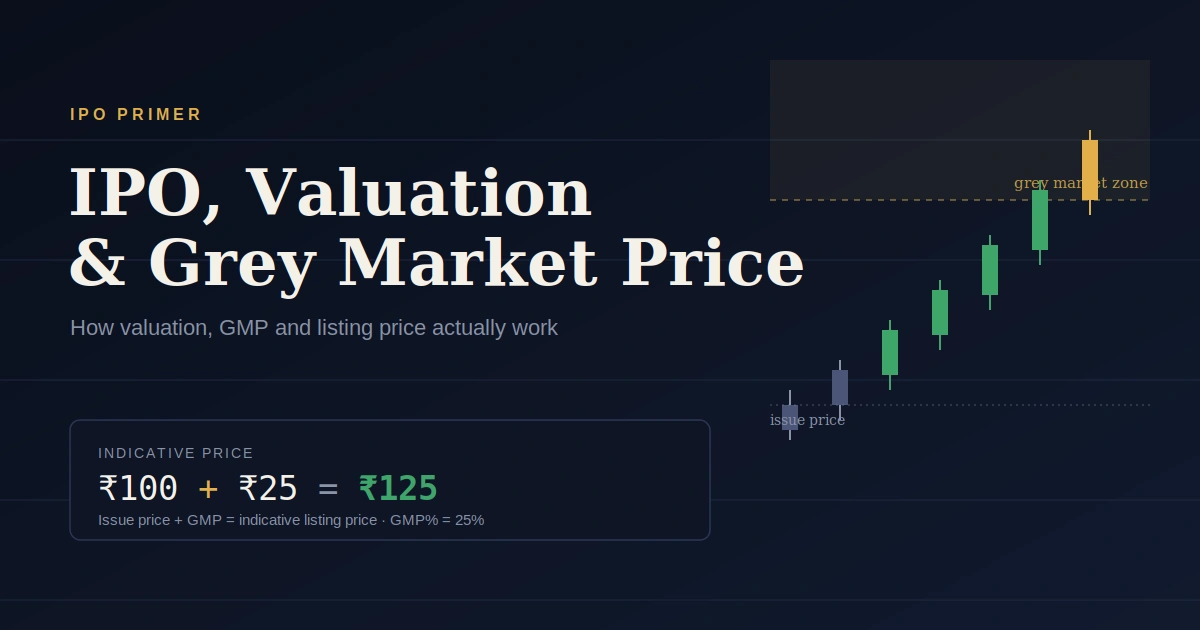
For example, if an IPO is priced at ₹100 and the grey market premium is ₹25, the indicative GMP-based price works out to roughly ₹125:
Indicative Price = IPO Issue Price + GMP
₹100 + ₹25 = ₹125
That ₹125 is only an indication based on the reported premium — not a guaranteed listing price.
The GMP percentage, similarly, is calculated as:
GMP % = GMP ÷ Issue Price × 100
₹25 ÷ ₹100 × 100 = 25%
This gives investors a quick sense of the premium being indicated in the grey market relative to the issue price.
Ultimately, an IPO is far more than a capital-raising exercise. It lets a company raise funds without the interest burden of debt, brings retail and strategic investors on board, improves transparency, strengthens the brand, and opens the door to the broader capital market.
For investors, understanding a company’s valuation and tracking its grey market price offers a useful early read on sentiment before the stock actually debuts.
But the grey market should always be treated as an informal signal — not an official or guaranteed forecast of the listing price. The actual listing, and everything that follows, will come down to market demand, supply, investor sentiment, company fundamentals, valuation, and the broader market environment.
1. What is the Grey Market Price (GMP) in an IPO?
GMP is the premium at which an IPO is informally traded in the unregulated OTC market before it lists. It indicates how the market is viewing the IPO, but it’s not a guarantee of the actual listing price.
2. How do you calculate the indicative listing price from GMP?
Add the GMP to the issue price: Indicative Price = IPO Issue Price + GMP. For example, ₹100 issue price + ₹25 GMP = ₹125 indicative price.
3. Is the grey market for IPOs legal or regulated in India?
No. The GMP is quoted in an informal OTC market that isn’t regulated by Indian stock exchanges or any official body. Because there’s no official data source, it’s tracked informally through brokers, market participants, and a handful of websites that report it — which makes it directionally useful but inherently less reliable than an exchange price.
4. What factors cause the GMP to change?
The GMP moves with peer company valuations, sector performance, government policy or sector-specific news, geopolitical developments, overall market sentiment, and the IPO’s subscription levels. A weak or falling market tends to dampen GMP and subscription; a bullish market tends to lift both — though neither guarantees the listing outcome.
5. Does a high GMP guarantee a strong listing gain?
No. A high GMP or heavy subscription can indicate positive sentiment, but the actual listing price depends on real-time supply and demand, investor sentiment, and broader market conditions on the day of listing — all of which can shift the outcome even from a strong GMP.
2 Comments