Coal India is going to bring another very significant subsidiary for an IPO after the highly successful IPO of Bharat Cooking Gas, which generated strong returns for shareholders. Following the success of the Bharat Gas IPO, a key exploration and important company, Central Mine Planning and Design Institute Limited (CMPDI), is now set to launch its IPO.
Central Mine Planning & Design Institute Limited (CMPDI) provides consultancy and support services across the entire mining lifecycle. Its work includes mine planning, design, exploration, environmental management, and technical solutions. The company mainly serves the coal sector but also works with other minerals like bauxite, lignite, and manganese.
CMPDI plays a key role in supporting mining projects from the initial exploration stage to the final closure of mines. Most of its work comes from Coal India Limited, which ensures steady business and long-term visibility.
Segment-wise Business Breakdown
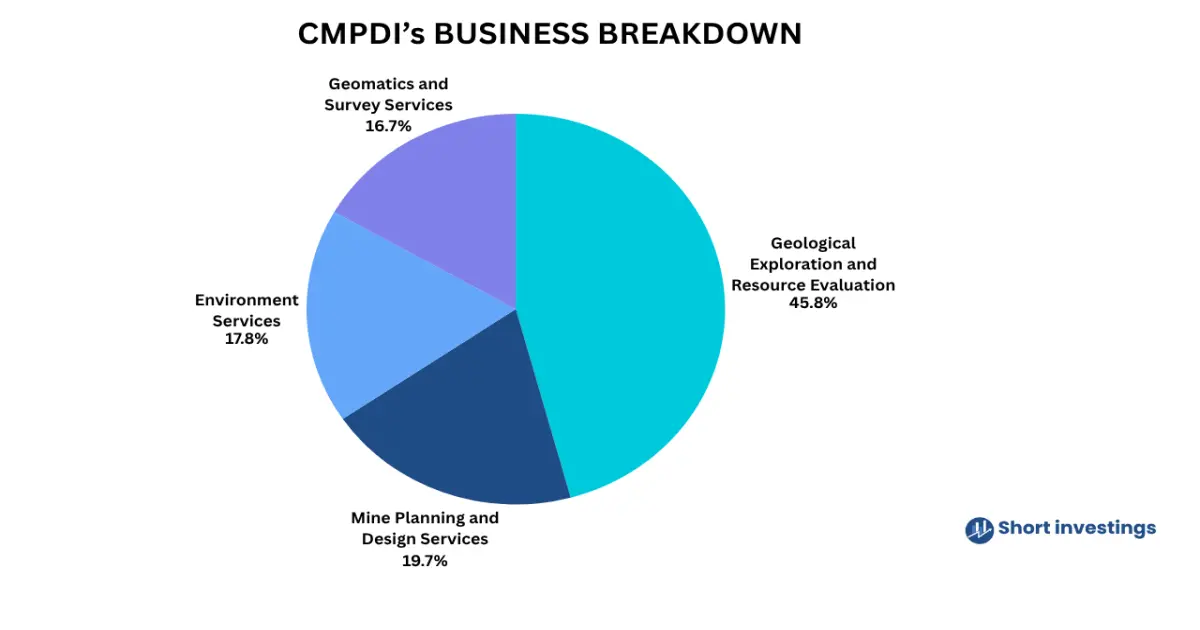
CMPDI earns its revenue from different services, but one segment clearly stands out.
The Geological Exploration and Resource Evaluation segment is the biggest contributor. It brings around 45–46% of total revenue, and its share has also increased over time. This means most of the company’s business comes from identifying and assessing coal and mineral resources, which is the first and most important step in mining.
The second major segment is Mine Planning and Design Services, contributing around 20–27%. This includes designing mines and planning how extraction will happen efficiently.
Other segments like Environment Services (around 17–19%) and Geomatics & Survey Services (around 14–16%) also contribute, but they are smaller compared to the first two.
The mining consultancy industry is growing steadily, supported by rising demand for minerals and increasing focus on efficient resource utilization. Globally, the sector has already seen consistent growth, and this trend is expected to continue in the coming years.
In India, the mining consultancy market is also expanding, driven by higher demand, supportive government policies, and technological advancements. As mining activities increase, the need for expert planning, design, and technical services is also rising.
As shown in the chart, India’s coal demand has been steadily increasing over the years and is expected to continue growing in the future. Total demand is projected to rise from around 800–900 MMT levels earlier to ~1,600+ MMT by FY35, showing a healthy long-term growth trend. Thermal (non-coking) coal remains the major contributor, while coking coal demand is also gradually increasing.
This growth is mainly driven by:
- Rising electricity demand (power sector)
- Expansion in infrastructure (steel, cement, aluminium)
- Government focus on energy security
In simple terms:
- Coal demand growth = More mining activity
- More mining activity = Higher demand for CMPDI services
This creates a strong and visible long-term opportunity for CMPDI. The company is not directly dependent on coal prices, but on activity levels in mining, which are expected to remain strong.
How does CMPDI’s business compare with its peers
When we compare CMPDI with its peers, the company shows a strong growth trend in recent years. CMPDI’s revenue has increased steadily from around ₹13,800 million in FY23 to over ₹21,000 million in FY25, reflecting a healthy growth rate of about 23%.
Also read : Dredging Corporation of India Business Model, Revenue & Industry Outlook 2025
On the other hand, larger players like RITES Limited and Engineers India Limited have seen a decline in revenues during the same period. This indicates that while they are bigger in size, their growth momentum has been relatively weaker.
Smaller peers like Mineral Exploration and Consultancy Limited (MECL) and MECON Limited have shown growth, but CMPDI stands out due to its strong connection with the coal sector and consistent project flow from Coal India Limited.
CMPDI’s business risk and opportunities
CMPDI has shown a strong improvement in its profitability over the last few years. Its PAT margin has increased from 21% in FY23 to 28% in FY24 and further to 31% in FY25, which reflects better cost control and efficient operations.
When compared with peers, CMPDI clearly stands out. RITES Limited has seen a decline in margins from 21% to around 18%, showing some pressure on profitability. Engineers India Limited (EIL) has improved its margins, but still remains lower than CMPDI.
Overall, CMPDI’s higher and improving margins indicate that the company is not only growing but also becoming more profitable, which is a positive sign for long-term performance.
CMPDI’s business is highly concentrated, with its top 10 clients contributing around 95% of total revenue. This shows that the company depends heavily on a limited number of large clients.
Most of these clients are directly linked to the coal sector, especially companies under Coal India Limited, such as Western Coalfields Limited, Eastern Coalfields Limited, and Bharat Coking Coal Limited. Along with this, government-related work from the Ministry of Coal also forms a significant part of revenue.
1. How much business comes from top clients?
Around 95% of CMPDI’s revenue comes from its top 10 clients, showing that the company works mainly with a limited number of large clients.
2. Who are the major clients of CMPDI?
Most key clients are from the coal sector, especially subsidiaries of Coal India Limited like Western Coalfields Limited, Eastern Coalfields Limited, and Bharat Coking Coal Limited, along with the Ministry of Coal.
3. Is high client concentration a risk?
Yes, it can be a risk because a large part of revenue depends on a few clients. If any major client reduces work, it can impact revenue.
4. Why is this concentration also a positive?
Because these clients are government-backed and financially strong, the business is stable and predictable, reducing default risk.
5. Does CMPDI depend only on Coal India?
Mostly yes, directly or indirectly. Since it is a subsidiary of Coal India Limited, a major portion of work comes from within this ecosystem.